
"Are You Mad at Me?" — Why I'm Recommending This Book to Every Client Who Struggles with People-Pleasing
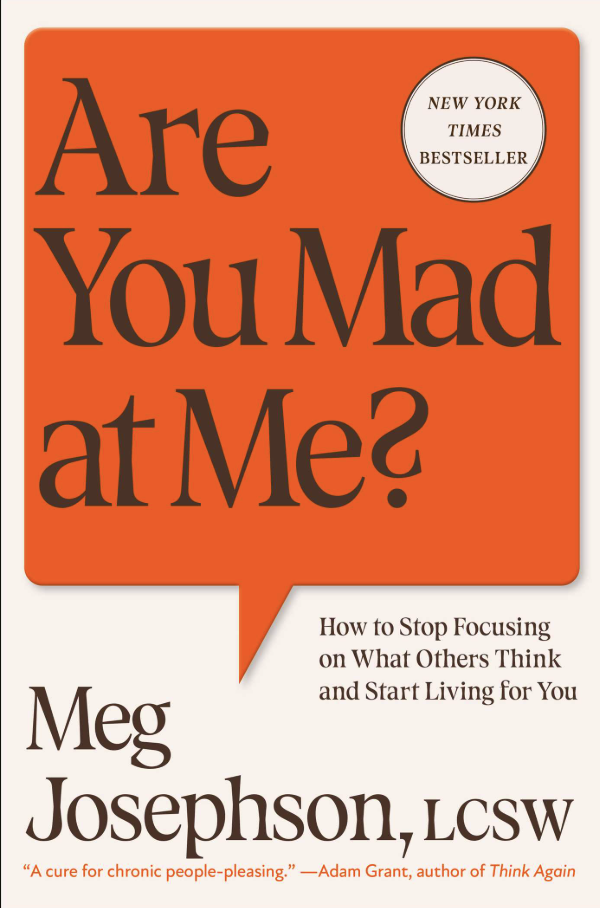
Are You Mad at Me? by Meg Josephson
If you've ever reread a text five times wondering whether a friend is upset with you, said yes when every part of you wanted to say no, or lain awake replaying a conversation from earlier in the day, this post is for you.
I read a lot of self-help books as a therapist. Most of them are fine. A few are genuinely helpful. And every once in a while, one comes along that I want to hand to almost everyone who walks into my office. Meg Josephson's Are You Mad at Me? How to Stop Focusing on What Others Think and Start Living for You is one of those books.
What the Book Is About
Josephson is a licensed psychotherapist, and her central idea is both simple and freeing: people-pleasing is not a personality trait. It's a survival response.
Most of us have heard of fight, flight, and freeze. Josephson focuses on a fourth response that gets far less attention: fawning. Fawning is what happens when, often early in life, we learn that the safest way to handle a threat is to become more agreeable, more helpful, more likable. We smooth things over. We read the room before we read ourselves. We become very good at keeping other people comfortable, and very out of touch with what we actually need.
The book was published in August 2025 by Gallery Books, and it blends Josephson's own story with client case examples and practical exercises. It's warm, readable, and never preachy. Many of my clients will finish it in a few sittings.
Why I Love It as a Therapist
What impressed me most is how clearly Josephson brings together three approaches I use every day in my own practice. These ideas can feel abstract when you first encounter them. She makes them feel human.
1. Radical Acceptance
Radical acceptance means fully acknowledging what is true right now, including feelings we wish we didn't have, without fighting it or judging ourselves for it. It doesn't mean approving of everything or giving up. It means we stop spending energy resisting reality so we can actually respond to it.
For people-pleasers, this is huge. So much anxiety comes from trying to control how others feel about us. Accepting that we can't control someone else's reactions is uncomfortable at first, and then, slowly, a relief.
2. Parts Work
Parts work invites us to see ourselves as having different inner "parts" with their own jobs and fears. The part of you that over-apologizes isn't the enemy. It's often a young, protective part that learned long ago that keeping the peace kept you safe.
Josephson describes several roles people-pleasers tend to play, such as the peacekeeper, the caretaker, the performer, the perfectionist, the chameleon, and the lone wolf. Many readers will recognize themselves in more than one. Seeing these patterns as protective parts, rather than character flaws, opens the door to self-compassion instead of self-criticism.
3. Somatic Work
Fawning doesn't just live in our thoughts. It lives in our bodies: the tight chest before a hard conversation, the stomach drop when someone's tone shifts, the automatic smile when we're actually hurt. Somatic work helps us notice these sensations and gently teach the nervous system that it is safe now.
I appreciate that Josephson doesn't stop at insight. Understanding why you people-please is important, but real change happens when your body begins to feel safe saying no.
Who Should Read This Book
I'd especially recommend Are You Mad at Me? if you:
Constantly worry that people are upset with you
Struggle to say no, then feel resentful afterward
Avoid conflict at almost any cost
Feel anxious, perfectionistic, or always "on"
Lose track of your own needs, preferences, or opinions around others
Grew up in a home where keeping the peace felt like your job
If several of these feel familiar, you're not broken. You learned a strategy that once protected you. The good news is that what was learned can be gently unlearned.
A Book Is a Great Start. Therapy Can Take You Further.
Books like this one can be powerful companions to healing. They give language to experiences that have felt confusing or shameful, and they help you feel less alone.
But patterns rooted in childhood and stored in the nervous system often need more than reading to shift. In therapy, we can:
Get curious about your specific protective parts and what they're trying to do for you
Practice noticing what's happening in your body in real time, with support
Explore where these patterns started, at a pace that feels safe
Rehearse boundaries and hard conversations before you have them
Build a relationship where you don't have to perform or please to be accepted
At KareKounseling PLLC, I work with adults in Lynnwood, WA and online who are tired of living for everyone else's approval. My approach draws on EMDR, IFS parts work, and somatic therapy, the same ideas that make this book so effective, tailored to your story.
Frequently Asked Questions
What is the fawn response?
The fawn response is a survival strategy in which a person tries to stay safe by pleasing, appeasing, or accommodating others. It often develops in childhood and can show up in adulthood as chronic people-pleasing, conflict avoidance, and difficulty identifying one's own needs.
Is people-pleasing a trauma response?
It can be. Not every act of kindness is a trauma response, but when pleasing others feels compulsory, anxious, or self-erasing, it is often a protective pattern the nervous system learned in order to feel safe.
Can therapy help with people-pleasing?
Yes. Approaches such as parts work, somatic therapy, radical acceptance, and EMDR therapies can help you understand where the pattern comes from, calm the nervous system, and build the confidence to set boundaries without overwhelming guilt.
Is Are You Mad at Me? a good book for anxiety?
For people whose anxiety centers on relationships, approval, or fear of conflict, your will find it very helpful. It's accessible, compassionate, and includes practical exercises. It isn't a replacement for professional care if your anxiety is significantly affecting your daily life.
Ready to Stop Wondering If Everyone Is Mad at You?
You deserve relationships where you can show up as yourself, including your needs, your preferences, and your "no." If this book resonates and you're ready to go deeper, I'd love to support you.
Schedule a free 20-minute consultation to see if working together is a good fit.
Warmly,
“Jane” I-Chen Liu. LMHC (WA). LPCC (CA). SEP™
KareKounseling PLLC
Serving clients online across WA and CA, in person therapy available in Lynnwood WA.

This post is for educational purposes and is not a substitute for individualized mental health care. If you are in crisis, call or text 988 (Suicide & Crisis Lifeline) in the U.S.
