

Internal Family Systems (IFS) Therapy
in WA & CA
A gentle, non-pathologizing approach to healing inner conflict

What is Internal Family Systems (IFS)?
If part of you knows exactly why you react the way you do, but another part still panics, shuts down or criticizes you anyway, you're not broken. You're made of parts. I'm “Jane” I-Chen Liu, an IFS therapist offering parts work therapy in person in Lynnwood, WA and online across Washington and California. If you've been looking for an Internal Family Systems therapist near you in the Seattle area, or one you can see from home, I'd be honored to support you.
Internal Family Systems (IFS) is a gentle, non-pathologizing approach to parts work therapy developed by Richard Schwartz, PhD. IFS sees your mind as a family of parts, like the inner critic, the people-pleaser, the part that numbs out and the hurt younger parts underneath. None of these parts are bad. Each one learned to protect you. In IFS therapy, we get curious about these parts, understand what they need, and help them let go of the burdens they've carried, so you can lead your life from a calmer, more compassionate place called Self.


The Main Parts in IFS
IFS started with sharing that we have managers part, firefighters, and exiles.
Managers who are responsible for our everyday tasks, to make sure that we do and do them well. Managers work very hard to avoid situations that may later on cause us pain.
Firefighters are there to make sure when our system gets overwhelmed, they can be there to shut it down. You might experience it like feeling numb, avoiding, and not wanting to move.
Exiles carry our trauma. Managers and firefighters might work very hard to make sure the exiles stay hidden to avoid pain.
IFS therapists see all these parts as carrying a story and function. In therapy, the purpose is to help these parts work together instead of having one part dominate the system. From experience, I see clients have many more parts that can surface in therapy sessions. We welcome them and provide these parts a safe place.
SELF Energy
Other than parts, IFS therapists see that we all have self-energy that are consist of confidence, calmness, creativity, clarity, curiosity, courage, compassion, connectedness, presence, patience, perspective, persistence, and playfulness.
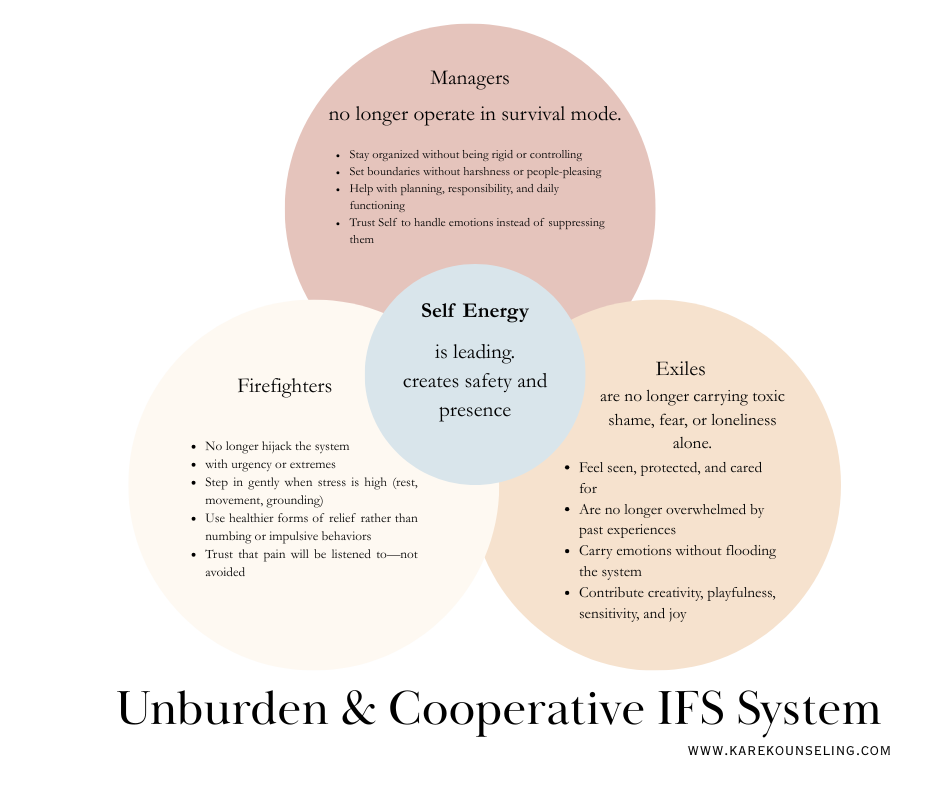
Healing in IFS therapy, Parts communicate instead of compete.
Managers listen to exiles rather than silencing them
Firefighters trust that emotions won’t destroy the system
Exiles no longer need to scream to be heard
Decisions are made with parts, not against them
There’s flexibility, choice, and internal collaboration.

How IFS Therapy Works?
In therapy sessions, I help clients learn to notice their parts, witness the burdens these parts are carrying, validate parts’ feelings, and learn to access self-energy to heal. Since I am also trained in Somatic Experiencing, I will be noticing how informations are showing up in your body. We will be providing support for your parts and for your body to restore balances.
What Healing Looks like
An unburdened system often experiences:
•Less inner criticism and urgency
•More emotional range without overwhelm
•Faster recovery after stress or conflict
•A felt sense of inner safety
•Self-trust instead of constant self-monitoring
Not perfection—resilience.
Other Ways I Use IFS
IFS for couples: In IFIO Couples Therapy, each partner learns to understand the protective parts that show up in conflict, so you can speak for your parts instead of from them.
IFS-informed intensives: My EMDR Intensives weave IFS and somatic work into longer, concentrated sessions for more intentional, uninterrupted healing.
WHY WORK WITH ME

Over the years, I’ve helped clients move beyond trauma, reconnect with their bodies, and feel more like themselves—more compassionate, calm, confident, courageous, and creative.
I blend inner child work, attachment-focused therapy, bilateral stimulation, somatic tracking, and nervous system healing to create deep, lasting change. My approach is trauma-informed, culturally responsive, and grounded in genuine compassion.
I understand how heavy things have felt, and I know how to help you find clarity, ease, and a more empowered relationship with yourself.
You’ve already taken a brave step by being here.
Let’s continue this journey — gently, intentionally, and together.
IFS Therapy FAQs
1. Is IFS evidence-based?
Yes, and the research is growing. In 2015, Internal Family Systems was recognized as an evidence-based practice by the U.S. government's National Registry of Evidence-based Programs and Practices (SAMHSA) for improving overall well-being. Studies have also shown reductions in depression, anxiety and PTSD symptoms. Many clients find IFS especially helpful for complex trauma, a harsh inner critic, shame and people-pleasing. These are patterns that often don't change with insight alone.
2. Can IFS be done online?
Yes. IFS works very well online, and many clients find it easier to turn inward from the comfort of their own home. I offer IFS therapy online for adults anywhere in Washington and California, and in person at my Lynnwood, WA office. All you need is a private, quiet space and a stable internet connection.
3. What's the difference between IFS and EMDR?
Both are powerful trauma therapies, with different focuses:
IFS (Internal Family Systems) helps you understand and heal the different "parts" of you, like the inner critic, the people-pleaser or the part that shuts down, and the hurt younger parts they protect.
EMDR (Eye Movement Desensitization and Reprocessing) helps your brain reprocess painful memories using eye movements, tapping or tones, so they stop feeling like they're happening now.
In short, IFS works with who inside you is carrying the pain, and EMDR works with the memories themselves.
4. Can IFS and EMDR be combined?
Yes, and this is a core part of how I work. Combining IFS and EMDR can make trauma healing feel safer and more complete. IFS helps us get to know the protective parts that might block or resist EMDR processing, so they're on board instead of fighting the work. EMDR then helps release the painful memories those parts have been guarding. I also weave in Somatic Experiencing, so your body stays grounded throughout. Many clients find this blend helps when EMDR alone felt too fast or got stuck.
Read More on the Blog






Virtual

Lynnwood WA

Hybrid
IFS Therapy in person in Lynnwood, WA and through telehealth for clients throughout Washington and California.