What Is CPTSD? Signs You Have Complex Trauma
If you’ve ever found yourself thinking, “Why do I react this way?”—especially in relationships, stress, or moments that seem “small”—I want to slow this down with you for a moment.
Because often, there’s a reason your system responds the way it does.
A lot of people I work with don’t immediately identify with the word trauma. There wasn’t one single, overwhelming event. Instead, there was a pattern over time—an environment that felt unpredictable, emotionally unsafe, or lacking in consistent care.
Something didn’t quite land the way it needed to.
And your body remembers that.
This is where Complex PTSD (CPTSD) comes in.

What Is CPTSD?
Complex PTSD (CPTSD) develops from ongoing, repeated experiences where your system didn’t feel safe, supported, or seen—especially in relationships.
This can include:
Growing up with emotionally immature or unavailable parents
Chronic criticism, shame, or emotional neglect
Having to read the room to stay safe
Caregivers who were inconsistent, controlling, or unpredictable
It’s not just about what happened.
It’s also about what was missing—like attunement, repair, and a sense that you could fully be yourself without consequences.
Over time, your nervous system adapts:
Staying on guard
Minimizing your needs
Prioritizing others to maintain connection
These aren’t random patterns. They’re learned ways of staying safe.
Signs You Might Be Living with Complex Trauma
CPTSD often shows up in ways that are easy to overlook, especially because many of these patterns become “normal” over time.
Here are some of the signs I commonly see:
1. Your Emotions Feel Intense—or Hard to Access
You might notice swings between feeling overwhelmed and feeling shut down.
Big emotional waves that are hard to regulate
Anxiety that shows up quickly
Numbness or disconnection
This is your nervous system doing its job—trying to protect you from overload.
2. Relationships Feel Important… and Complicated
There’s often a deep desire for connection, alongside a sense that something doesn’t quite feel safe.
Fear of abandonment or being too much
People-pleasing or overextending
Difficulty trusting
Pulling back when things start to feel close
It can feel like different parts of you want different things at the same time.
3. There’s a Strong Inner Critic
You might notice an internal voice that’s constantly evaluating, pushing, or criticizing.
“I should be better than this”
“What is wrong with me?”
“I need to get it together”
This part often developed to help you adapt in environments where being “easy,” “good,” or “low-maintenance” felt safer.
4. You Track Other People’s Emotions Closely
You may be highly attuned to shifts in tone, mood, or energy.
Scanning for tension or disconnection
Feeling responsible for keeping things smooth
Struggling to say no without guilt
Putting others’ needs ahead of your own
This kind of awareness can be a strength—but it can also be exhausting when it’s always on.
5. There’s a Layer of Shame That’s Hard to Shake
This isn’t just guilt about something you did. It’s a quieter, deeper feeling of “something about me isn’t okay.”
You might notice:
Self-doubt that lingers, even when things are objectively going well
Holding back parts of yourself in relationships or spaces that matter to you
Questioning your worth in ways that feel automatic, not chosen
This kind of shame often forms in environments where your inner world wasn’t fully seen, reflected, or validated—where you had to adjust who you were in order to stay connected or safe.
If you want to go deeper into this, I wrote more about toxic shame in a previous blog—what it is, how it forms, and how it shows up in everyday life.
6. You Feel Stuck in Patterns You Understand Logically
This is the part that can feel especially frustrating.
You might have insight. You’ve read the books. You get it.
And still:
The same relationship dynamics repeat
Your body freezes, shuts down, or reacts quickly
It’s hard to follow through on what you “know”
Because this isn’t just cognitive. It’s physiological. It lives in the nervous system.
Why CPTSD Often Gets Missed
Many people minimize their experiences, especially when there wasn’t a clear “big trauma.”
Thoughts like:
“It wasn’t that bad.”
“Other people had it worse.”
“My parents did what they could.”
And at the same time, your system may have been working very hard to adapt to something that didn’t feel safe or steady.
Both can exist together.
This isn’t about labeling your past in a certain way.
It’s about understanding how your system learned to survive—and how that might still be showing up now.
What Healing from CPTSD Can Look Like
Healing here isn’t about pushing yourself to “move on” or overriding your reactions.
It’s about building safety—slowly, and in a way your system can actually receive.
That might include:
Noticing and getting to know different parts of you (parts work / IFS)
Processing experiences that feel stuck (EMDR)
Learning how to track and regulate your nervous system (somatic work)
Practicing boundaries in ways that feel doable, not overwhelming
Developing a different relationship with yourself—one that includes more steadiness and care
This work takes time. And it’s not linear.
But shifts do happen—often in small, meaningful ways at first.
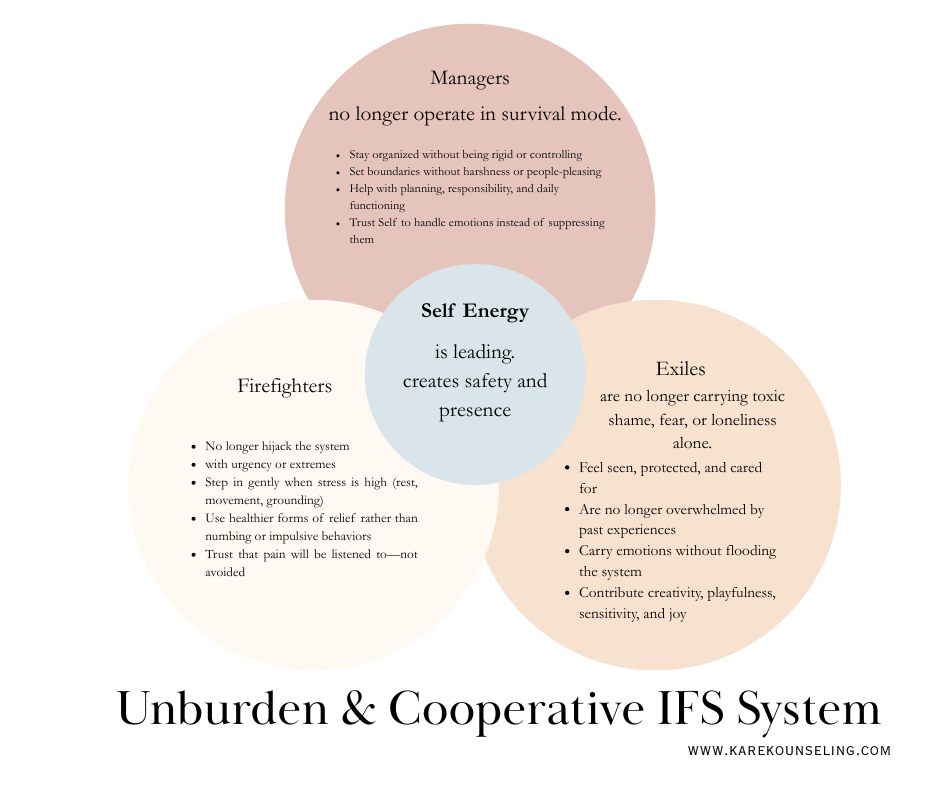
This is a sample of how a heal CPTSD internal system could look and feel like.
A Different Way to Understand What You’re Experiencing
If you’re recognizing yourself in some of this, I want you to hear this:
Your patterns make sense in the context of what you’ve been through.
There’s nothing random about the way your system responds.
There’s intelligence in it.
And there are ways to work with it—gently, and at your pace.
If You’re Wanting Support
If you’re navigating complex trauma or CPTSD, therapy can be a space to begin untangling some of these patterns with support.
I’m a somatic trauma therapist based in Washington State. (Hi! I’m Jane). I integrate EMDR, parts work (IFS), and Somatic Experiencing to support clients in working through childhood and relational trauma.
If this resonates, you’re welcome to reach out and explore whether this kind of work feels like a fit. Reach out here.
