Why Is It So Hard to Set Boundaries with Our Parents? (A Trauma Therapist’s Perspective)
I recently had the privilege of being interviewed on the Untethering Shame podcast, where we talked about developmental trauma, toxic shame, setting boundaries, and emotional healing.
If you prefer reading, I’ve summarized the core ideas below—and hopefully, it sparks your curiosity to listen to the full conversation.
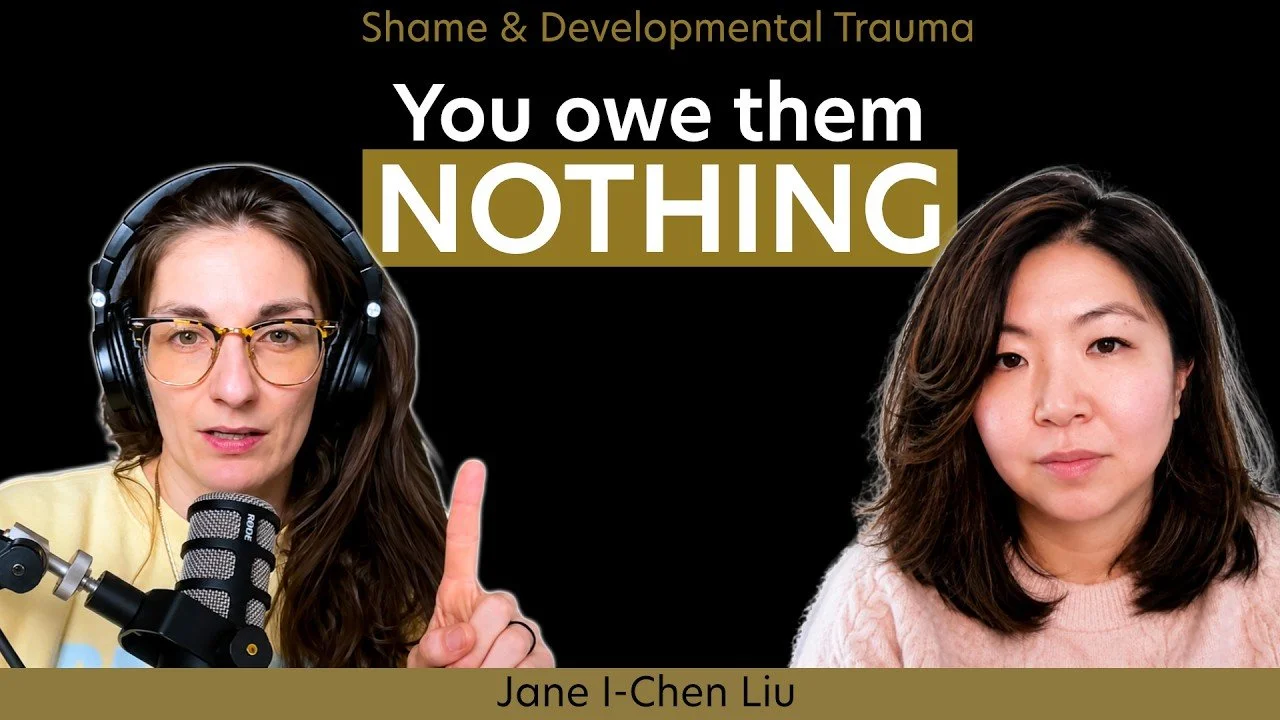
Why Boundaries with Parents Feel Like Danger
One of the first questions I was asked on the show was: Why is it often so much harder to set boundaries with our parents than with anyone else?
It's a question I know personally.
Earlier this year, when I returned to Taiwan to celebrate Lunar New Year, I made a decision that felt surprisingly difficult: I stayed in a hotel instead of my parents' home.
In many Asian cultures, that decision can be seen as disrespectful or distant. But for me, it wasn’t about rejecting my family—it was about recognizing that my nervous system needed a safe, quiet space to recharge.
Growing up, my boundaries were often crossed in subtle ways:
Belongings gone through without asking.
Food choices and body image commented on regularly.
Decisions made on my behalf long past childhood.
Choosing a hotel wasn't about creating emotional distance. It was about showing my inner self: "I am an adult now. I have choices. I can care for myself."
Boundaries Are a Nervous System Experience
Many people think setting boundaries is simply a communication skill—learning how to say "no."
In my work as a trauma therapist, I see something much deeper: Setting boundaries is a nervous system response.
As children, our survival depended on staying connected to our caregivers. Our brains learned that closeness equaled safety. Decades later, disappointing a parent can trigger a primal threat response.
You may intellectually know you have the right to set a boundary, but your body experiences that "no" as danger. That is why so many people feel intense guilt, fear, or panic when breaking long-standing family patterns.
The Difference Between Healthy Shame and Toxic Shame
A fundamental concept I often revisit—and one that was central to our podcast discussion—comes from the work of Dr. Laurence Heller, founder of the NeuroAffective Relational Model (NARM). Through NARM, which focuses on healing developmental trauma, I gained a much deeper understanding of how shame shapes our capacity for connection and boundary-setting.
NARM distinguishes between two distinct types of shame:
Healthy Shame: A brief, adaptive response focused on behavior ("I made a mistake"). It prompts reflection and helps us repair relationships when we've caused real harm.
Toxic Shame: An internalized, identity-level belief ("There is something wrong with me"). It creates deep isolation and convinces us that our core self is flawed or broken.
Toxic shame rarely stems from a single event. More often, it develops through hundreds of tiny childhood moments:
Being criticized without explanation.
Feeling unseen or emotionally dismissed.
Believing love must be earned through performance or compliance.
Healing Without Blame: Moving Past All-or-Nothing Family Choices
Social media often gives us two extreme choices when dealing with difficult parents:
Forgive and forget everything.
Cut your family off completely.
Real life requires more nuance. Most parents parented from their own unhealed wounds. Understanding that doesn't erase the hurt, but it helps us approach healing with both compassion and self-protection.
Healing can look like:
Rebuilding a relationship with new ground rules, new experiences, and updated nervous system.
Setting clear, healthy space—whether physically, emotionally, or both—so you can feel relatively safe.
Choosing not to change the other person, but shifting how you protect your peace when you’re together.
Learning a New Inner Language
Healing often begins when we start speaking to ourselves in a new way. For many of my bilingual clients, phrases like "It's okay to make mistakes" or "I'm proud of you" don't translate easily—not because the language lacks the words, but because they never heard them growing up.
Reparenting is the process of adopting an internal language rooted in self-compassion rather than criticism.
Listen to the Full Podcast Episode
In the full conversation on Untethering Shame, we dive much deeper into:
How trauma and family patterns are stored in the physical body.
Practical everyday steps for reparenting yourself.
Navigating cultural expectations while honoring your personal needs.
🎧 Where to Tune In:
Watch on YouTube: Untethering Shame Episode
Listen on Spotify / Apple Podcasts: Adversity Rising Podcast
Final Thought: Healing doesn't begin by proving you are enough. It begins by discovering that you always were.

“Jane” I-Chen Liu, MA. LMHC. SEP™, owner of KareKounseling PLLC, is a licensed trauma therapist in Lynnwood, WA who specialize in CPTSD, sexual abuse, medical trauma, and complex issues clients have with their family of origin. Jane is passionate to work with people who had been carrying too much on their own. Learn more about Jane here.
